
Fetch vs Retrieve: Why I Don’t Recommend Fetch (But I Do Teach a Retrieve)

Let’s talk about one of the most common games people play with their dogs — fetch.
If you’ve followed me for a while, you’ll probably already know that I don’t recommend repetitive, high-arousal fetch games.
But dogs – and owners – love to play it. So what’s the issue?
And more importantly… what’s the difference between fetch and a trained retrieve?
In reality, there is a huge difference between repetitive, adrenaline-fuelled ball chasing and a calm, structured, trained retrieve.
🚫 Why I Don’t Recommend Traditional Fetch
A typical game of fetch often looks like this:
Throw ball
Dog sprints
Dog skids
Dog grabs
Dog spins
Throw again
Repeat… and repeat… and repeat.
Many dogs quickly become:
• Hyper-fixated on the ball
• Over-aroused and unable to switch off
• Frustrated when the game stops
• Obsessed with the toy to the point of behavioural fallout
There are also potential physical risks, including:
• Repetitive strain on joints
• Sudden twisting at high speed causing muscle strain
• Increased injury risk from braking, thought to be the most dangerous part of ball chasing.
Emotionally, this type of game is usually adrenaline-driven rather than thoughtful or regulated.
For many dogs — particularly working breeds with strong chase instincts — fetch becomes less about enrichment and more about compulsion.
Each repetition builds more arousal and adrenaline, with the dog going straight from chase to chase with little opportunity to regulate.
This is often why high drive dogs – even with significant joint disease will still continue to perform self rewarding tasks like ball chasing despite being in significant pain.

🎯 A Structured Retrieve Is Completely Different
Now let’s look at a trained retrieve.
A retrieve — especially in gundog-style training — is calm, intentional and structured.
Instead of constant chasing, the pattern becomes:
Wait → mark → retrieve → return → deliver → pause → reset
The dog must:
✔️ Control their impulse and wait for the cue
✔️ Mark where the item has fallen
✔️ Go out when directed
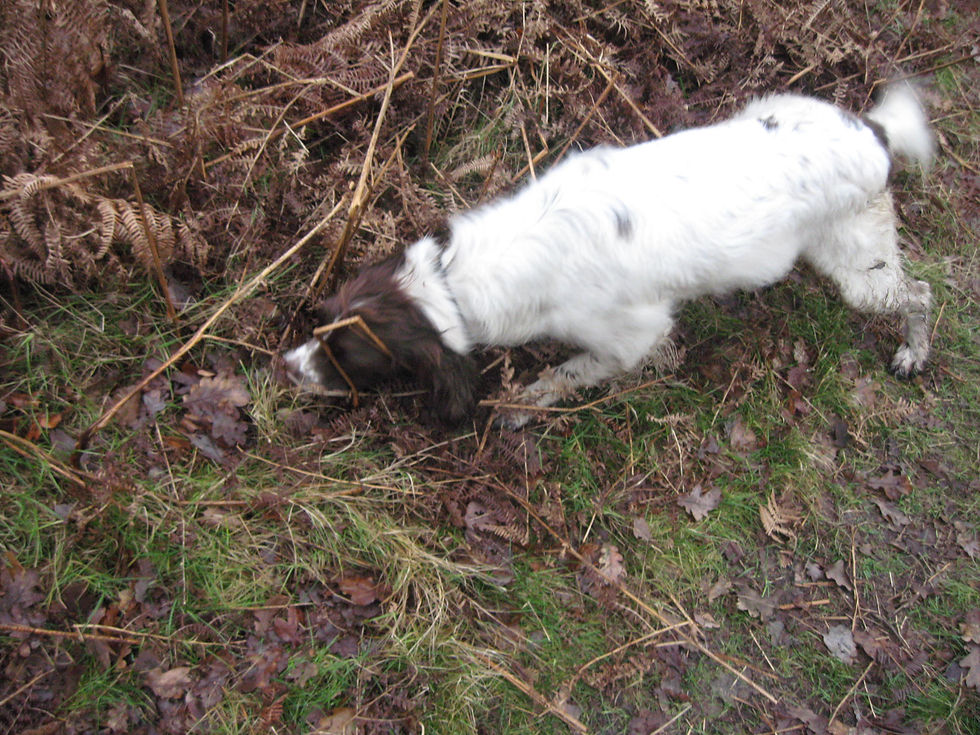
✔️ Use their nose if needed
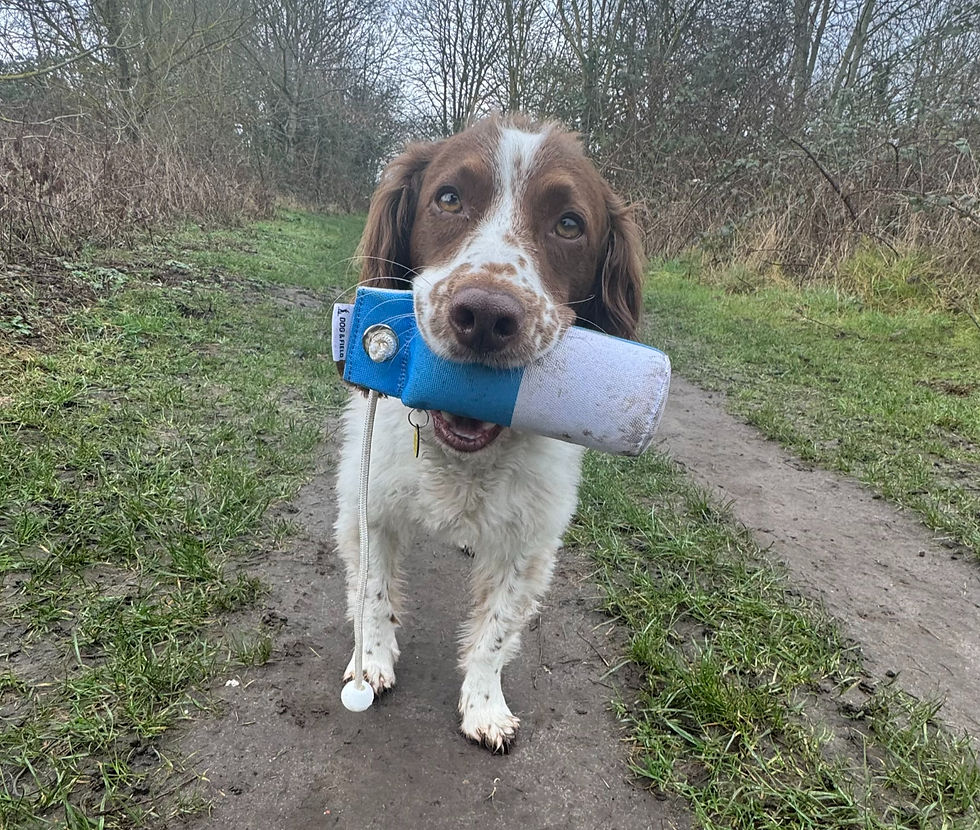
✔️ Pick up the item
✔️ Return to their handler
✔️ Deliver calmly
This creates a completely different emotional state.
The dog isn’t just chasing — they’re thinking, problem solving and working in partnership with their handler.
That’s engagement, not obsession.
And crucially, there is time between retrieves for the dog to regulate before the next task.
🧠 Why Retrieve Work Is So Valuable
Structured retrieve training helps build:
• Self-control• Focus
• Clear communication
• Physical coordination
• Confidence
• A strong working relationship
In gundog training, retrieving is fundamentally a cooperative task.
The dog learns:
"Go out, find and collect the item, and bring it back to me."
This changes the motivation from self-rewarding chase to shared work with the handler.
As a result, we often see:
• Improved recall
• Stronger handler focus
• Calmer behaviour around thrown objects
• Better impulse control

🐾 Retrieves Also Slow the Game Down
Another key difference is rate of reinforcement.
Typical fetch often looks like:
Throw → throw → throw → throw → throw
Retrieve training looks more like:
• One retrieve
• Pause
• Reset
• Possibly another retrieve
Those pauses matter.
They allow the dog’s nervous system to settle, preventing the build-up of frantic excitement.
🐕 It’s Not the Object — It’s the Process
Retrieving a ball, dummy or toy isn’t the issue.
The real difference lies in:
• Arousal levels
• Structure
• Clear start and finish
• Quality over quantity
One promotes regulation.
The other often fuels dysregulation.
✨ Final Thought
I don’t recommend fetch as a mindless, repetitive adrenaline game.
But I absolutely teach a retrieve.
Because when done properly, it’s not just a game.
It’s skill-building, relationship-building and brain-building.
And that changes everything.
Comments