
Why Placeboard Training Matters for Busy, Active Dogs
If you live with a busy, active dog — particularly a spaniel or working breed — you’ll know how important structure, clarity and impulse control are in everyday life.

Placeboard training is a simple but highly effective tool owners can use to teach these skills in a way that makes sense to enthusiastic, fast-moving dogs. It provides a clear framework for learning, helping dogs slow down, think, and make better choices — without dampening their drive or personality.
What Is Placeboard Training?
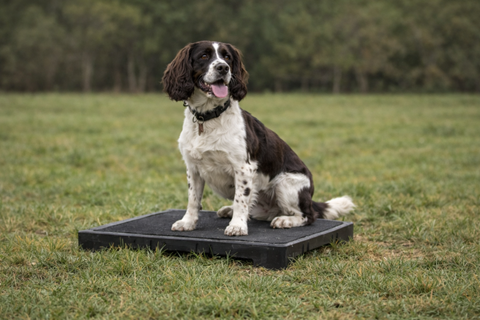
A placeboard is a raised, clearly defined platform used as part of a training setup.Rather than relying solely on verbal cues, the placeboard gives you a visual and physical reference point that helps your dog understand:
• Where you’d like them to be
• When they should wait
• When they’re free to move
The board itself doesn’t “train” the dog — instead, it supports clear communication, making it easier for you to teach and for your dog to succeed.

Teaching Impulse Control with a Placeboard
Placeboards are a valuable tool for teaching dogs how to pause and think before acting.
Used thoughtfully, they allow you to practise:
• Waiting for permission
• Choosing stillness over impulsive movement
• Remaining settled even when excitement levels rise
These impulse-control skills are especially important for busy dogs and also form an essential foundation for gundog-style training, where steadiness and self-control are key.
Using a Placeboard to Build Reliable Stays & Work Around Distractions
A placeboard gives you a clear structure for teaching a stay, rather than expecting your dog to understand the concept in isolation.
With the board as a reference point, you can gradually and fairly:
• Increase duration
• Add distance
• Introduce movement and distractions
• Practise calmly around other dogs
Because the dog has a defined place to return to, it’s easier for them to understand the task — and easier for you to adjust the difficulty at the right pace.

Teaching Patterns: Retrieve Foundations, Recall & Directional Cues
Placeboards are particularly useful when you’re beginning to teach retrieve-style patterns, recall and early directional cues.
By using a placeboard as a clear starting or waiting point, you can help your dog learn:
• When to move away from you and when to return
• How to come back promptly and calmly on recall
• How to follow simple directional information without rushing or guessing
This structure is especially helpful for enthusiastic dogs who are keen to move but need support learning control within movement.
Proprioception: Helping Dogs Understand Their Bodies
Placeboards also support the development of proprioception — your dog’s awareness of where their body is in space.
Stepping onto, standing on, and moving on and off a raised surface encourages dogs to:
• Adjust their weight and foot placement
• Move with better balance and control
• Be more thoughtful in how they use their bodies
Final Thoughts
Placeboard training is a simple but powerful teaching tool.
For busy pet dogs, spaniels and working breeds, it helps owners teach impulse control, build reliable stays, practise calm behaviour around distractions, and lay strong foundations for gundog-style training.
Used well, placeboards create clarity, confidence and calmer dogs — while keeping training positive, engaging and fair.


Comments